
Managing risks for shooting sports
Key takeaways:
- If schools want to offer trap shooting or archery to students, they should develop a written policy that outlines all the rules.
- The National Archery in the School Program (NASP) offers clear guidance on how schools can introduce archery safely.
- Whether students are on the school grounds or traveling off-site, they should be guided by an individual who has undergone required training in that shooting sport.
Any time a school introduces a shooting sport (such as trap shooting or archery) into curricular or extracurricular activities, there are myriad risk management concerns. However, schools shouldn’t be discouraged; they simply need to be very methodical when addressing each of the potential risks.
There are two primary ways in which students will participate in shooting — at an off-site location or on the school grounds (either indoors or outdoors). It’s imperative that schools develop written policies that specify how they will keep students and staff safe.
Off-site locations
A trap-shooting club will need to find a sponsoring location, and an archery club may need to travel off-site as well. When such a club is traveling:
- Every student should have a parent or guardian sign a consent form. This form should clearly spell out the dangers associated with recreational shooting and clear the school of any liability, should an accident occur. The form should be approved by the school’s legal counsel.
- Staff members/advisers need to examine the location in advance to ensure it follows all regulations for that particular sport. Not only should the proprietors be following all applicable laws, but they should also have a current certificate of insurance or be listed as an additional insured with the school.
- An adequate number of staff members/chaperones need to be present. This largely depends on the age and number of students involved.
- At least one staff member present should have first aid and cardiopulmonary resuscitation (CPR) training. Additionally, advisers and chaperones should know which students have allergic reactions that require epinephrine pens and be aware of any medical concerns before the trip.
On the school grounds
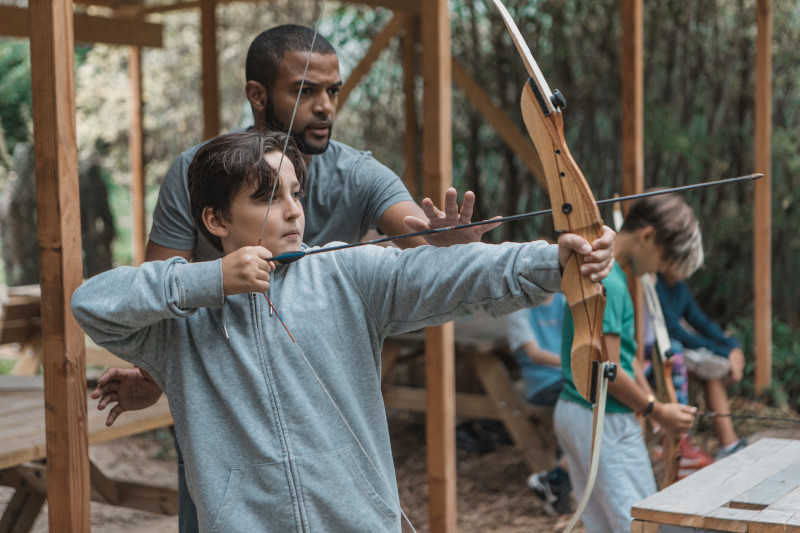
Some high schools, middle schools and even elementary schools offer archery as part of their physical education curriculum. Additionally, they may want to set up a range for an after-school club. The following are the most important rules for archery on school grounds:
- First and foremost, the staff member or volunteer in charge needs to be a certified archery instructor. They should be able to prove they’ve completed a certification course and serve as range master at all times.
- Whether the archery range is indoors or outdoors, it should be set up according to national specifications. The National Archery in the Schools Program (NASP) provides standards for ranges at schools.
- Use whistle commands to standardize rules inside the range. The NASP prioritizes whistle commands — two blasts to enter the line, one to shoot, three to retrieve and five or more for emergencies. Whether students are shooting for class or a club, it’s important that they receive education on the whistle commands before setting foot in the range.
- During the activity, all students and adults are prohibited from entering the range until the range master gives the “all clear.” To enforce this rule, an adequate number of adults must be present, depending on the age of the students. For example, if a teacher is working with 4th grade students, they should recruit volunteers according to NASP guidelines. A good general best practice is 8-12 students per volunteer/adult. That can be adjusted by age (more volunteers for younger children).
- Equipment should be stored in a secure location. A bow and arrow are weapons that can cause considerable harm, and they should be treated as such. The range master should never leave the equipment unsupervised –this is why it’s so important to have volunteers and/or other staff members available. When target practice has concluded, all equipment must immediately be moved to a locked closet or a storage location that can be secured.
- A first aid kit should always be available, as well as a trained staff member. As with off-site trips, staff members should be prepared to address any emergencies quickly and efficiently.
Both kinds of target shooting can be quite beneficial for students — but it’s important that school leaders do their homework before introducing a potential liability.
Click here for more student safety and risk management tips.
Safety while shooting
Q: What are the two main ways students participate in school shooting sports?
A: Students participate either at an off-site location (such as a trap range) or on school grounds, indoors or outdoors.
Q: What safety steps are required for off-site shooting activities?
A: Schools should collect signed parent consent forms, verify the facility follows regulations and has insurance, provide adequate supervision and ensure at least one staff member is trained in first aid and CPR.
Q: What standards should schools follow for archery on campus?
A: A certified instructor must always supervise and the range should meet national standards set by the National Archery in the Schools Program (NASP).
Q: Why is careful planning important before introducing shooting sports?
A: While shooting sports can benefit students, schools must proactively manage safety risks and liability concerns to protect students and staff.